Home
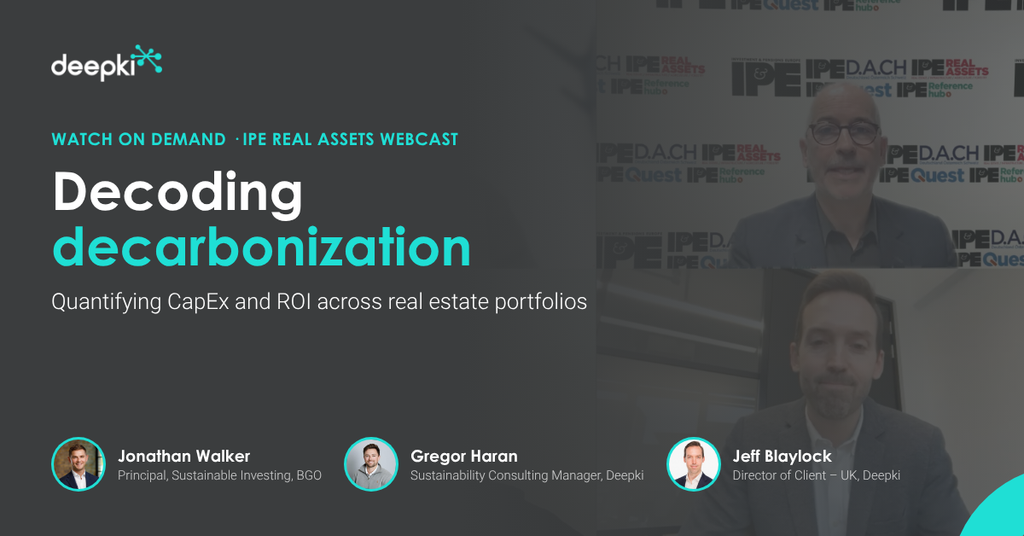
Decarbonisation CapEx no longer gets a free pass on sustainability grounds. In our recent IPE webcast, BGO and Deepki argued it now has to win the same argument as any other capital decision: where the next pound or euro protects the most value.
For several years, sustainability spending had the luxury of not having to explain itself. Targets were set, frameworks were completed, and retrofit budgets were justified by the strategy they supported.
Higher interest rates and tighter budgets have changed that. Since 2022, the conversation about decarbonisation CapEx has moved from how it supports a sustainability strategy to what it pays back, and when. That can sound like bad news for sustainability. On the evidence shared in the webcast, it is the opposite: closer scrutiny is producing better decisions.
Jonathan Walker, who leads BGO’s European sustainability initiatives, joined Deepki’s Jeff Blaylock and Gregor Haran to work through how investors are quantifying CapEx and ROI in practice. Four ideas stood out, and together they point to a different way of building the investment case.
1. The mandate sets the decarbonisation strategy, not the other way round
The most useful reframe of the session was also the simplest. Decarbonisation is now an unavoidable investment consideration, but it sits inside the mandate. It does not replace it.
In core and core plus strategies, CapEx is about preserving income and reducing obsolescence risk. In value add, the opportunity may be to buy an underperforming asset at the right basis and improve it as part of a wider repositioning. Neither means an inefficient building is automatically a bargain. The acquisition price has to reflect the cost, complexity, disruption and execution risk of the works.
Asset class changes the answer again. In logistics, rooftop solar can create a new income stream while meeting tenant needs. In offices, the case leans towards plant efficiency, electrification and the occupier experience that drives leasing. In life sciences and data centres, the conversation is about operational demand, grid capacity and reliability.
The portfolio question becomes one of marginal benefit: which asset turns the next pound into the most value? For one building, that is a deep refurbishment. For another, a modest efficiency upgrade. BGO’s London office team, for example, uses whole life carbon to decide whether to refurbish or redevelop. At Regent’s Wharf, a mix of refurbishment and new build meant the refurbished elements carried roughly half the embodied carbon of the new build, with operational carbon targeted to fall by around 50%.
Our view: blanket targets spread evenly across a portfolio are one of the most reliable ways to misallocate capital.
2. Transition risk belongs in the price on day one
Traditional due diligence tells you a boiler or roof is nearing the end of its life. That is no longer enough. The question now is whether the replacement will meet the building’s future performance requirements, and what extra investment that will take.
The regulatory cliff edges that once felt distant now sit inside a normal hold period. In the UK, the proposed minimum EPC B requirement for larger commercial buildings lands around the turn of the decade, well within the life of an asset bought today. So the sharper question is what comes after it.
The next buyer will assume compliance as a given and look further ahead, to operational energy and carbon intensity and a credible path to net zero. Lenders are increasingly asking the same questions. Reporting frameworks are moving the same way: GRESB, CRREM and the UK Net Zero Carbon Buildings Standard are converging on actual building performance rather than disclosure for its own sake.
The practical consequence is that an asset bought today is underwritten against the next buyer’s checklist, not today’s.
3. Simple payback undersells the real return
Where tenants pay the utility bills, the landlord funds the upgrade and the tenant captures most of the energy saving. That split makes simple payback a weak lens for an investor. The real return sits in what the work prevents and what it creates.
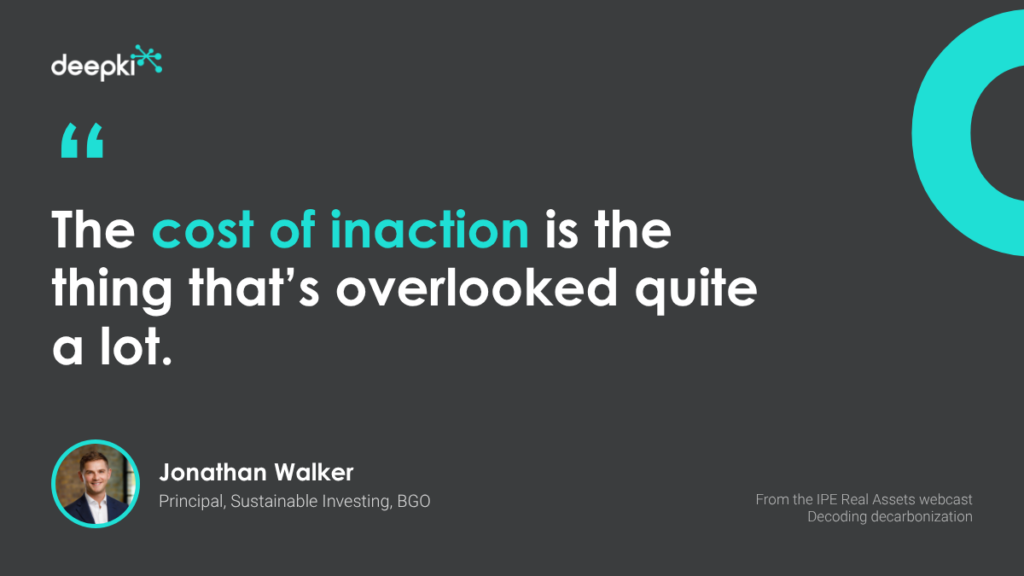
What it prevents is the cost of inaction, which is the figure most often left out of the model. Skip the work and the asset risks longer voids, weaker appeal to institutional occupiers, costlier works at the next lease expiry and a narrower pool of buyers at exit, any of which can force a liquidity event.
What it creates can be new income. With energy prices high across the UK and Europe, a landlord-funded rooftop solar installation on a logistics asset, paired with a power purchase agreement that sells to the tenant below market rate, works for both sides. Add battery storage and the case strengthens further.
BGO’s own results show how this flows through to rent. In its UK logistics core plus portfolio, upgrades timed with the normal replacement cycle (new steel roofs, LED lighting, all-electric heating, EV charging) took average EPC ratings from D and E to B. The units let within three months of completion, at rents 60 to 75% above previous levels and around 20% ahead of business plan.
This also explains how valuers treat sustainability. As Jonathan put it during the Q&A, they rarely apply a lower cap rate just because a building is certified. Instead, sustainability shifts the assumptions underneath the valuation: expected rents, letting periods and incentives.
4. Price the brown discount before chasing the green premium
The green premium is real in some markets: prime London offices, prime offices in other European capitals, and increasingly logistics, where Jonathan pointed to CBRE research showing a widening gap in rental and capital growth between efficient and inefficient assets. But it is hard to isolate. Sustainability is bound up with good design, location, age, specification and tenant covenant, and pulling one thread from that bundle is difficult.
The brown discount is easier to see. A portfolio averaging EPC D that needs significant CapEx to reach B will be discounted until a buyer is comfortable it can get there. That is capital at risk, and it is measurable today.
The same logic applies to certification. The discussion suggested that the biggest step in value comes from moving an asset from uncertified to certified, not from moving between the top grades. Whether to certify a whole portfolio depends on asset type: a baseline across a logistics portfolio is instructive, while certifying every unit of a multi-let retail scheme may not yet be the best use of capital.
For lenders, the downside lens is sharper still. A loan typically runs three to five years; the building runs for decades. An asset can stay compliant through the loan term and still face major expenditure shortly after, which matters most where the business plan relies on refinancing rather than sale. Interestingly, talk of sustainability-linked margin discounts has quietened. The underlying economics of tenant demand, retention and exit liquidity are now strong enough to make the case on their own.
Stranded assets, a phrase that faded from use for several years, is back in the vocabulary of long-term investors.
Four questions to ask of every asset
Rather than labelling an asset as carrying transition risk, the webcast landed on four questions that turn that risk into a number. They apply whether you own, occupy or lend against the building.
- What investment is required? A costed, asset-level view of the works, not a theoretical risk flag.
- When will it be needed? Aligning upgrades with the replacement cycle and lease events is usually the most efficient route. Low-cost measures such as BMS optimisation, controls, LED lighting and submetering often deliver strong risk-adjusted returns, provided they do not simply defer a structural problem.
- Who pays, and who benefits? Tenants are central, especially in single-let and logistics assets where they control utilities and equipment. Green lease clauses with data-sharing provisions, agreed at the outset, make everything after easier. In BGO’s experience, around nine in ten of these conversations go well, helped by the fact that most European occupiers have commitments of their own.
- What does doing nothing cost? Model the voids, incentives, future CapEx and exit discount that inaction brings, and compare it with the cost of acting.
The answers differ building by building, which is why portfolio averages hide the assets that will cause problems. They also depend on data that is rarely complete. Automatic meter reading helps more than any other single step, because it is set up once and then runs, rather than relying on quarterly collection.
From targets to deliverable plans
The shift running through the whole discussion is from setting targets to delivering them. Decarbonisation is no longer something to aim at broadly and hope to hit. It is a set of specific, costed decisions, each tested on where the value sits.
That is the work Deepki does with owners, occupiers and lenders: translating energy and carbon performance into the financial KPIs an investment committee uses. Its AI archetype model starts guiding decisions from minimal building information and sharpens as more data arrives, while specialist real estate experts test each action against what works on site. Where tenant data is missing, Deepki fills the gaps with benchmarks built from actual operational data across more than 900 customers, so the plan rests on the clearest picture available.
Watch the full conversation. The webcast goes further on each of these points, including audience questions on valuation evidence, portfolio certification and tenant data.

If you would rather test these ideas against your own portfolio, we can model your CapEx plan privately. Contact us now to learn more!