

 Home
89% of European logistics occupiers expect to need more power, and 26% say their buildings already fall short. Grid capacity has moved from the facilities checklist into the investment case, shaping rents, financing and exit values asset by asset.
For a decade, the logistics investment case rested on location. Get the motorway junction, the labour pool and the catchment right, and the asset would let.
That is no longer enough. The 2026 European Logistics Census from Savills and BGRE, based on 628 responses from occupiers, developers and investors, finds that 89% of occupiers expect their power requirements to rise. More than a quarter, 26%, say the buildings they occupy today already lack the capacity they need.
Operations are electrifying and automating faster than the grid connections behind them. For owners, lenders and developers, that gap is now a question of whether an asset stays lettable, financeable and valuable.

What the market is telling us
The Census points one way: demand is concentrating on buildings that can carry heavier, more automated operations.
- Demand for power is rising. 89% of occupiers expect their requirements to increase over the next three years. Among manufacturers, it is 93%.
- The shortfall is already in today’s leases. 26% report insufficient capacity in their current portfolio.
- Technology will add load. More than half of occupiers plan to invest more in AI, and 42% in warehouse automation.
- Power is the top barrier to new supply. 77% of developers name power availability, ahead of planning timescales (73%) and construction costs (62%).
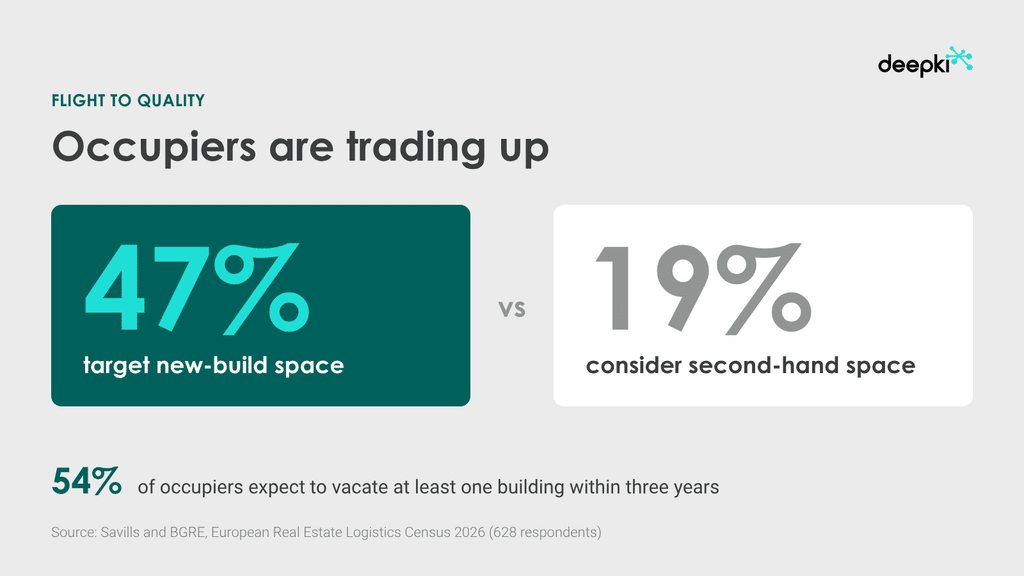
- Occupiers are trading up. 47% target new-build space against 19% considering second-hand buildings, and 54% expect to vacate at least one building within three years.
Savills’ own conclusion is direct: power is no longer an overlay sitting next to the investment case. It is part of the investment case.

From grid capacity to asset value
Power used to be checked late in a deal. It now feeds directly into the numbers each party around an asset cares about.
For investment and asset managers, it sets the depth of the occupier pool, and with it NOI and exit value. A building with secured capacity competes for the strongest tenants. One without it risks longer voids, bigger incentives and a lease event that becomes an exit. Savills notes that a building can come back to the market not only because an occupier is shrinking, but because it can no longer supply the power, height or yard the occupier needs.
For developers, it decides deliverability. With 77% citing power as a barrier, schemes that resolve their grid connection early face far less real competition, even where headline vacancy looks high.
For lenders, it is collateral risk. An asset whose power constraints limit its future occupiers carries refinancing and exit exposure that a standard valuation may not show.
The answer differs building by building. Two warehouses on the same estate can have very different connection headroom, consumption profiles and upgrade costs. Portfolio averages hide exactly the assets that will cause problems.
Four questions to ask of every logistics asset
A power-ready review starts with four questions, answered asset by asset, before the next lease event or refinancing.
- What does the building draw today? Actual metered consumption, not design assumptions.
- What will the next occupier need? Electrified fleets, charging, automation and AI all add load. Model the realistic tenant profile, not the current one.
- What can the grid supply, and when? Connection headroom and upgrade queues vary sharply between sites, even within one region.
- Which upgrades widen the occupier pool at a viable cost? Compare on-site generation, storage and connection upgrades by cost, payback and value impact. Where none stack up, that asset’s obsolescence risk belongs in the hold or sell decision now.
Who wins the next cycle
The logistics market is not short of demand. It is short of buildings that can meet it. Savills expects selectivity, not a fall in demand, to shape the next phase, with performance decided asset by asset.
That splits the market in two. The winners will be the owners who know the power position of every building before a tenant or lender asks, and who have already decided which assets to upgrade, which to reposition and which to sell. They will let faster, refinance on better terms and exit into a deeper pool of buyers.
The rest will find out at the lease event. The occupier leaves for a better-powered building, the void runs longer than the business plan assumed, and the grid upgrade that might have saved the asset is still sitting in a connection queue.
Power used to be a line in technical due diligence. It is now one of the clearest dividing lines between assets that hold their value and assets that lose it.
Stay ahead of what moves real estate value. Follow Deepki on LinkedIn for analysis like this every week, and request a demo to see how owners, lenders and occupiers use Deepki to assess energy and power risk across their portfolios.
Sources
Savills and BGRE, Spotlight: European Real Estate Logistics Census, Savills Research, 6 October 2026. https://www.savills.co.uk/research_articles/229130/394906-0
Full report (PDF): https://pdf.euro.savills.co.uk/european/european-commercial-markets/european-logistics-real-estate-census-2026.pdf
All survey figures in this article come from this report.